
The pentatonic scale on guitar: the 5 positions explained
It is the scale behind rock, blues and most of the solos you know. Five notes, five positions: here is how to learn it and connect it across the whole fretboard.
In short
- The minor pentatonic has five notes: the root, minor third, fourth, fifth and minor seventh.
- In A minor that gives A, C, D, E, G. The same notes form the C major pentatonic.
- The fretboard splits into five positions that link together; moving between them is how you play everywhere.
Five notes, no more
The pentatonic drops two notes from the natural minor scale: the second and the sixth. Those are the notes that clash the most. The result: almost everything sounds right, which makes it the ideal scale for improvising.
Take A minor as a starting point: A (root), C (minor third), D (fourth), E (fifth), G (minor seventh). On the low E string, the root sits at the 5th fret.
The 5 positions on the fretboard
Position one, the best known, fits within four frets starting at the 5th fret: two notes per string, with the index and little finger doing most of the work.
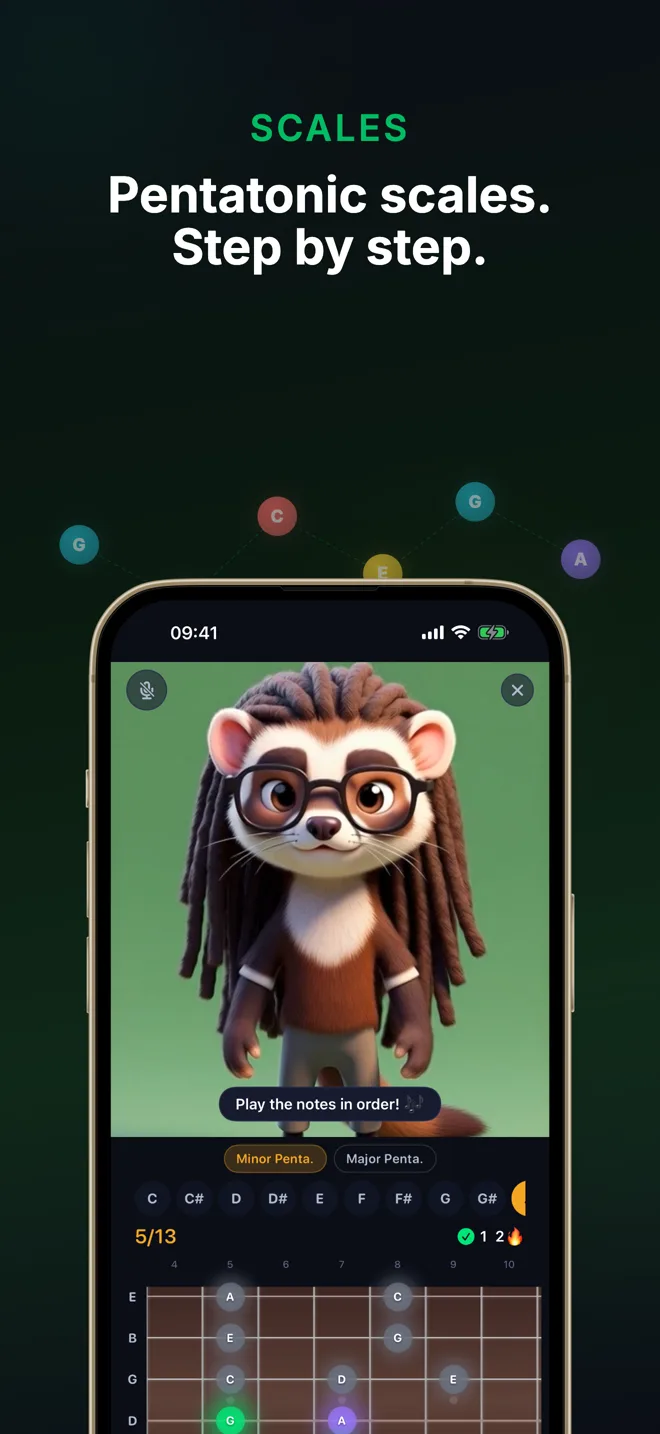
The other four positions use the same notes higher up the neck. Each position shares its left-hand notes with the right-hand notes of the previous one: that overlap lets you slide from one to the next without breaking the phrase.
Summary table
| Position | Landmark | Remember |
|---|---|---|
| 1 | Root under the index finger, low E string | The basic “box”, learn it first |
| 2 | Starts on the minor third | Connects position 1 towards the high end |
| 3 | Starts on the fourth | Often used for bends |
| 4 | Starts on the fifth | Classic blues phrasing area |
| 5 | Starts on the minor seventh | Meets position 1 an octave up |
A two-step method
One position a week
Play it slowly, up and down, until you no longer look at your fingers.
Check every note
With Guitar Scale Quest the app listens and confirms the note you played, so you correct mistakes instead of repeating them.
Frequently asked questions
What is the difference between minor and major pentatonic?
They share the same notes with a different starting point: A minor pentatonic contains the notes of C major pentatonic.
How long does it take to learn all 5 positions?
It depends on your practice. One position at a time, practised regularly, is the most reliable approach.
Do I need to read music?
No. Positions are shapes on the fretboard; knowing note names helps you change key.

The SHIP IT team
We design and build the SHIP IT apps, and write these guides from what we learn along the way.
The intervals and positions described are standard music theory. Guitar Scale Quest is made by SHIP IT, the author of this article.